
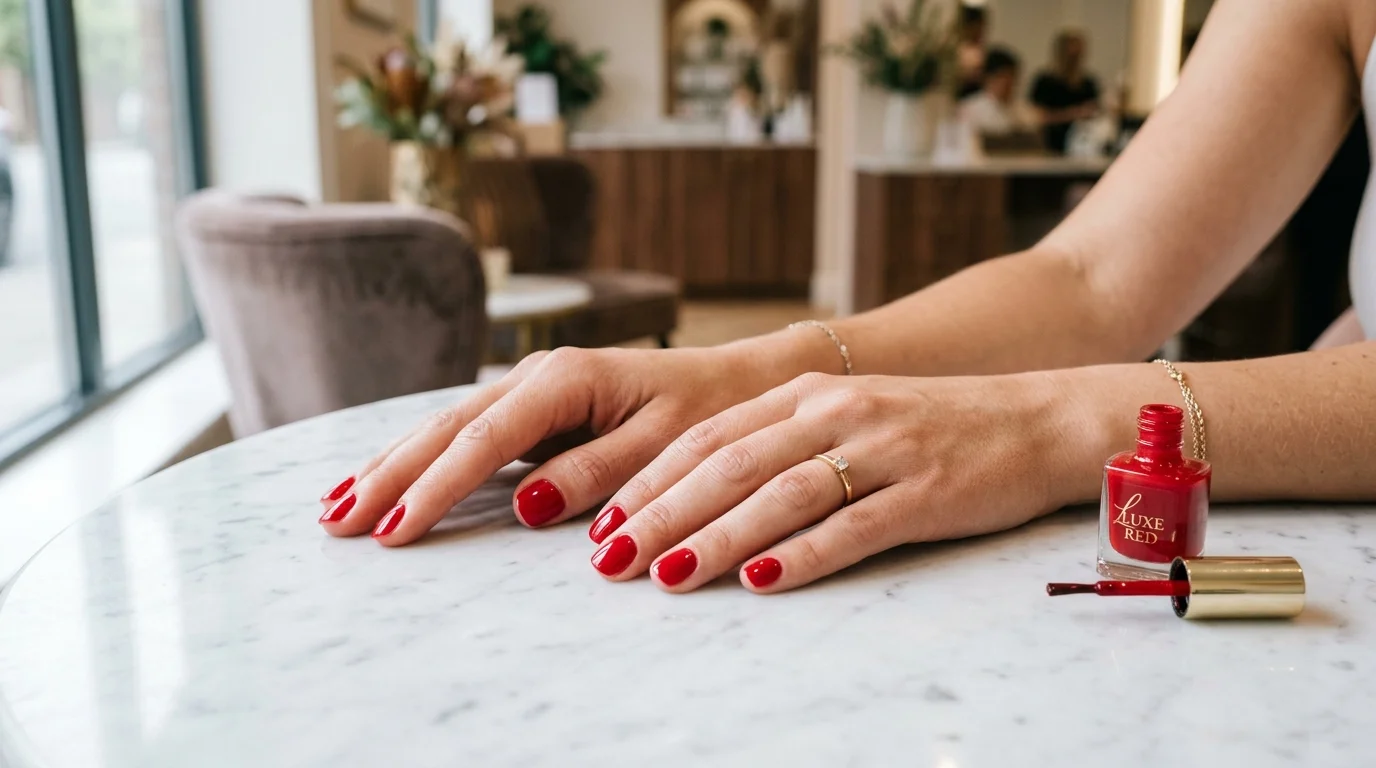
Few beauty mishaps feel as defeating as spending thirty minutes painting your nails, only to brush against your car keys and ruin the entire finish. When planning a fresh manicure, knowing how long does nail polish take to dry is essential to avoid smudging your hard work. While your fingertips might feel smooth after a brief wait, the layers underneath remain delicate for much longer than most people realize. Understanding the difference between a surface-set finish and a truly dent-proof seal saves you time, frustration, and wasted product.
Here is everything you need to know about drying timelines, common chemical traps, and expert techniques to get flawless results every time.
How Long Does Nail Polish Take to Dry? Quick-Reference Timeline
In general, standard nail lacquer takes between 15 to 20 minutes to become touch dry, but it takes 1 to 2 hours to fully cure. Touch dry means you can gently tap the surface or handle light objects like a smartphone without leaving marks. Fully cured means the resins have hardened down to the natural nail plate, making the finish resistant to pressure, fabrics, and accidental knocks.
Knowing how long does nail polish take to dry helps you plan your day around your manicure so you never rush out the door with wet hands.
“Touch Dry” vs. “Fully Cured”: The Real Chemistry of Polish
Traditional nail lacquer dries through solvent evaporation, not chemical cross-linking like gel. Inside the bottle, solvents like ethyl acetate and butyl acetate keep the nitrocellulose film-formers liquid. Once applied to the nail, these volatile solvents begin to evaporate into the air.
The top layer meets the air first, forming a solid skin within minutes. However, the trapped solvents in the bottom coats must slowly migrate upward through that top skin to escape. This explains why your nails can survive a light fingertip brush after 15 minutes, yet slide off in a gooey sheet when you dig into your handbag an hour later.
True dent-proof durability only occurs when every trace of liquid solvent has cleared the film. If you have ever wondered how long does nail polish take to dry from the base coat to the top coat, two hours is the golden rule for absolute safety.
3 Pre-Painting Mistakes That Double Your Wait Time
Most people blame the brand of polish when drying takes forever, but the preparation phase often sets you up for failure before the brush ever touches your hands.
-
Skipping the Alcohol or Acetone Wipe: Natural oils, hand creams, and residual cuticle remover leave a greasy film on the nail plate. When you apply polish over oil, the base coat cannot bond properly, creating a soft barrier that traps evaporating solvents underneath. Always dehydrate your nail beds with rubbing alcohol or pure acetone before starting.
-
Vigorously Shaking the Bottle: Shaking a bottle creates tiny pockets of trapped air within the viscous liquid. When painted onto the nail, these micro-bubbles prevent smooth, uniform evaporation and cause soft spots in the finish. Instead, roll the bottle gently between your palms to mix pigments without adding air.
-
Applying Over a Tacky Base Coat: Many people rush to add color while the base coat is still glossy and wet. A wet base layer locks in moisture, easily doubling the overall drying duration. Give your base layer at least two minutes to settle before applying your first swipe of color.
5 Major Factors That Dictate Your Polish Drying Time
No two manicures dry at the exact same speed. Several variables influence how fast nail polish dries:
-
Layer Thickness and the Inter-Coat Wait: Heavy, thick layers are the primary cause of smudging. Two or three paper-thin coats dry significantly faster than one thick layer. Always wait at least two to three minutes between coats of nail polish to let each pass breathe.
-
Pigment Density: Sheer, nude, and pastel shades typically dry faster than deep reds, navy blues, and rich blacks. Darker formulas require heavier pigment loads to achieve opacity, and dense pigmentation slows solvent evaporation.
-
Special Finishes and Glitters: Chunky glitters, metallic foils, and textured finishes often contain heavier suspension bases. While glitter feels solid quickly, the clear suspension base underneath takes longer to set thoroughly.
-
Clean and “Free-Of” Formulations: Formulas that are 5-free, 7-free, or non-toxic intentionally omit harsh hardeners like formaldehyde resin and camphor. While gentler on nails, these clean polishes dry more slowly than conventional alternatives.
-
Room Temperature and Ambient Humidity: High humidity in your room fills the air with moisture, slowing down the rate at which solvents can vaporize. A cool, dry room provides the best drying environment.
When calculating how long does nail polish take to dry, always factor in your room environment and the shade you choose.
The Sheet Marks Dilemma: When Can You Sleep or Wear Shoes?
Waking up with the texture of your bedsheets pressed into your fresh manicure is an infamous frustration. This happens because sustained mechanical pressure acts differently than a quick brush against an object.
Even after 90 minutes, your polish might resist a tap, but the constant weight of your body pressing your nails against cotton blankets over six to eight hours will mold the semi-pliant lacquer into an uneven texture.
For manicures, wait at least two hours before going to bed. If you are doing a pedicure, wait a full three to four hours before putting on socks or closed-toe shoes. Tight footwear compresses the sides of the nail, ruining smooth edges even on polish applied earlier in the afternoon.
How to Test If Nails Are Dry Without Leaving Fingerprints
Never press your thumb pad or finger into fresh polish to see if it has set. Your fingerprint will transfer directly onto the surface, ruining your hard work. Instead, try these two reliable methods:
-
The Pinky Edge Tap Test: Bring your two pinky fingernails together so that the outer edges tap lightly against each other. If there is any sensation of stickiness, tackiness, or pulling, your nails are still wet. If they make a crisp, hard click and separate smoothly with zero resistance, your surface is stable.
-
The Scent Indicator: Solvents have a strong, pungent, chemical scent during the active evaporation stage. As the polish cures, this scent diminishes. Lean in close and smell your nails: if the chemical smell remains sharp and strong, solvents are still actively evaporating, which means the deeper layers are still soft.
Knowing how long does nail polish take to dry keeps you from checking too early, but the tap test offers the safest confirmation.
Proven Ways to Make Your Nail Polish Dry Faster
If you do not have two hours to sit motionless, you can speed up the process using reliable methods:
-
Cool Air Circulation: Position your hands in front of a small electric desk fan or use the cool shot button on your hair dryer. Keep the air source at least eight to twelve inches away so the airflow does not create surface ripples. Never use warm or hot air, as heat keeps lacquer resins soft and pliable.
-
Quick-Dry Top Coats: High-performance top coats contain fast-evaporating ingredients that penetrate downward, pulling volatile solvents out of the underlying color layers as they dry.
-
Fast-Drying Silicone Drops: Quick-dry drops or dry sprays form a light barrier over the top layer. These products pull solvents outward while coating the outer film in slippery silicone, helping you avoid smudges if you accidentally bump your hands.
-
Wiping the Brush Clean: Before sweeping the brush over your nail, wipe one side completely against the bottle neck and remove excess polish from the stem. Applying ultra-thin coats reduces your wait time between layers to under two minutes.
Using these techniques makes a huge difference if you are wondering how long does nail polish take to dry when you are in a rush.
Popular Drying Myths That Actually Damage Your Manicure
The internet is filled with DIY hacks for drying nails, but many of them ruin your manicure:
-
The Ice Water Bath Myth: A widespread rumor suggests dipping wet nails into a bowl of ice water for three minutes instantly hardens them. While icy water thickens the top surface, it shocks the polish, trapping liquid solvents underneath and creating microscopic pockets of moisture. This causes premature chipping and peeling within 24 hours.
-
Cooking Spray or Baby Oil: Spraying vegetable oil on your nails does not speed up solvent evaporation. It only creates a temporary lubricant on top of the nail. While this might help a stray object slip off the surface without catching, the lacquer underneath dries at its normal pace.
-
Using a UV Lamp on Regular Polish: Placing regular lacquer under an LED or UV lamp does not cure the polish. UV lamps only work on photo-initiators found in gel products. Standard lacquer requires airflow to evaporate solvents, and the slight heat from nail lamps can cause regular polish to bubble.
Avoiding these bad tips ensures you get the expected result every time you evaluate how long does nail polish take to dry.
How to Fix an Almost-Dry Smudge Without Starting Over
If you bump your nail and cause a minor dent while the polish is still semi-pliant, you do not have to remove the entire layer:
-
Lick Your Fingertip: Gently wet your opposite index fingertip with a tiny drop of saliva. The natural moisture prevents your skin from sticking to the lacquer.
-
Smooth the Surface: Lightly press the pad of your wet finger directly over the dent and smooth the displaced polish back into place using gentle, sweeping strokes.
-
Re-level with Top Coat: Once smoothed, apply a thin coat of fast-acting clear top coat. The fresh solvents in the top coat melt the uneven edges together, leveling out the dent.
This simple emergency technique saves your manicure if you miscalculate how long does nail polish take to dry during routine tasks.
Why Hot Showers and Washing Dishes Ruin Fresh Nails
Even after the standard two-hour mark, your polish remains vulnerable to prolonged hot water and steam. Nitrocellulose, the primary film-forming polymer in nail polish, softens when exposed to high heat and water immersion.
Taking a hot shower, soaking in a bath, or washing dishes with bare hands within four hours of a manicure causes the natural nail plate to expand with absorbed water. Because your nail plate swells while the polish cannot, the bond between the polish and nail weakens. Once the nail cools and shrinks back to its standard size, the lacquer lifts, cracks, and peels away at the free edge. Always wear protective rubber gloves when cleaning and schedule your showers well before painting your nails.
FAQs
Why does my nail polish take so long to dry?
Nail polish stays wet when applied in thick coats, when old or gooey polish is used, or when painted in high-humidity rooms. Forgetting to remove natural nail oils with alcohol before applying a base coat also slows drying.
How long does nail polish take to dry with two coats?
Two thin coats of regular nail polish take about 15 minutes to become touch-dry and about an hour to fully harden. If you skip waiting two minutes between coats, the combined layers can take over 90 minutes to cure.
Can nail polish dry without air?
No. Regular nail polish relies on open air to let its volatile liquid solvents evaporate. Without sufficient air circulation, the lacquer cannot transform into a hard, protective film.
Does cold air actually help nail polish set faster?
Yes. Cool air from a fan or hair dryer speeds up the natural evaporation of volatile solvents without melting or softening the film-forming polymers.
How long does nail polish take to dry before applying a top coat?
Wait two to three minutes after your second coat of color before brushing on your top coat. This brief window prevents the brush from dragging the pigment while letting the color coat set enough to bond with the final protective layer.



















Leave a Reply