
Imagine finding a sparkling ring tucked away in an old family heirloom box, or spotting a brilliant gemstone at a local thrift shop. Instantly, a wave of curiosity hits you along with a burning question: is this the real deal, or just a clever imitation? In the jewelry world, authenticity is not always clear to the naked eye. Knowing how to tell if a diamond is real can protect you from getting scammed, help you value an inheritance, or give you peace of mind regarding a recent purchase.
Before diving into the screening methods, we need to address a modern jewelry fact: the distinction between natural and lab-created stones. If you are holding a synthetic lab-created diamond, it is crucial to know that it is chemically, physically, and optically identical to an earth-mined diamond. Because it is genuine carbon, a synthetic stone will pass every single home test exactly like a mined stone. Today, we are focusing on weeding out actual lookalikes, known as fakes or simulants, so you can test your jewelry with confidence.
Tier 1: Quick At-Home Diamond Tests (Zero Tools Required)
If you want to run an immediate real vs fake diamond check, you can perform a few simple diagnostic tests right now without spending a penny. These structural tests rely on the basic physical properties of carbon.
The Fog Test (Thermal Conductivity)
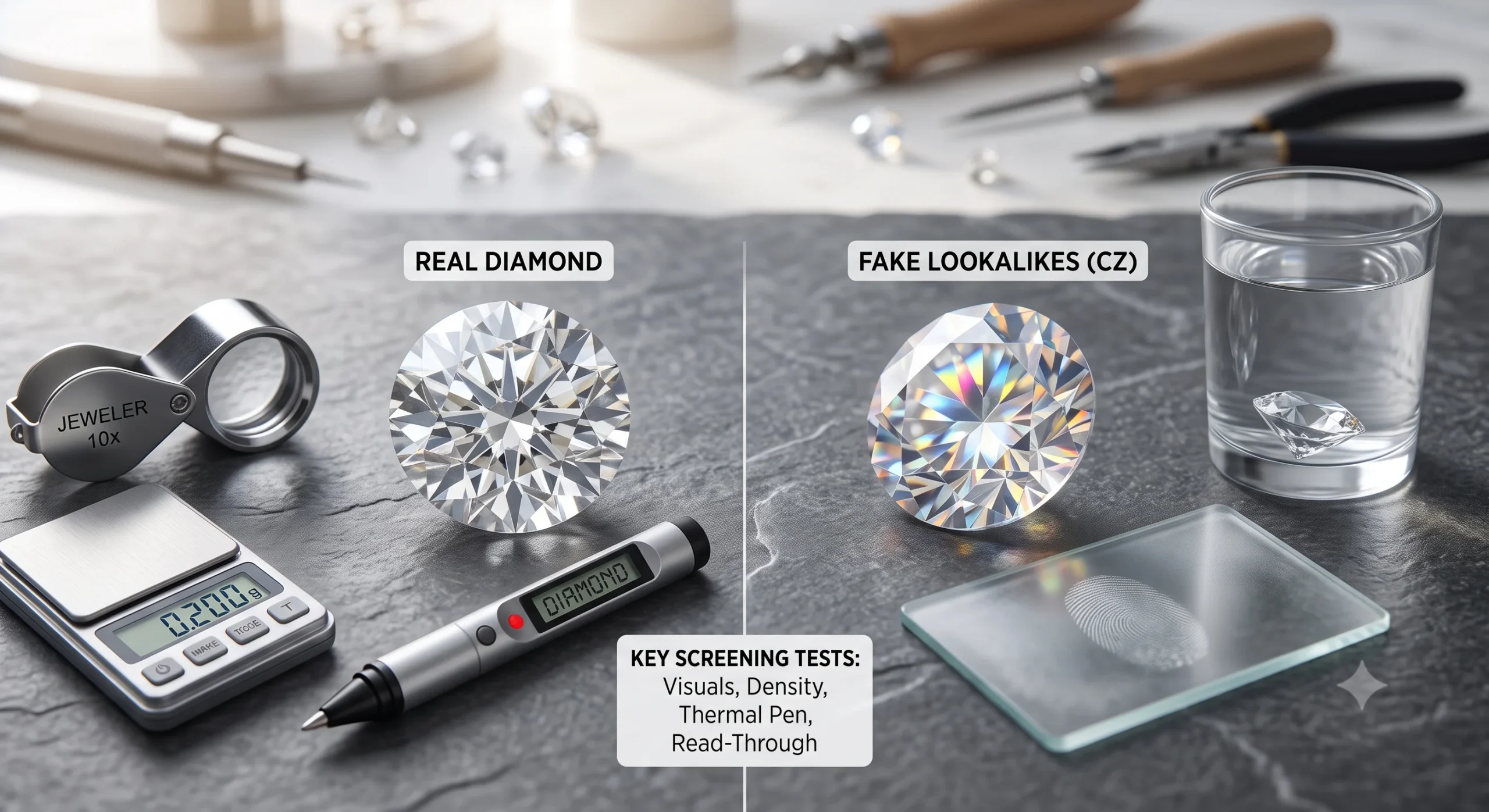
Diamonds are elite heat conductors, meaning they disperse warmth almost instantly. To perform the clean-stone fog test, hold the gem securely between two fingers and breathe directly onto it with warm air, exactly as if you were trying to mist up a window. If the stone is genuine, the fog will clear in less than a second. However, high-quality fake diamonds like glass or cubic zirconia will retain the moisture, staying cloudy for two to four seconds. Note that oil and dirt can throw off the results, so ensure the gem is clean before exhaling.
The Water Test (Relative Density Scale)
This evaluation relies on the relative density scale of different minerals. Keep in mind that this test is only possible with a loose stone that is completely unmounted. Take a clear glass, fill it three-quarters full with water, and gently drop your stone inside. A genuine diamond has a very high density of roughly 3.51 grams per cubic centimeter, causing it to sink straight to the bottom of the glass. While cheap glass or plastic alternatives might float or bob near the middle, you must remain cautious: cubic zirconia is actually heavier than diamond and will also sink quickly, meaning this test only rules out low-density materials.
The Read-Through / Dot Test (Refractive Index)
Because of the incredibly high refractive index of diamond, light bends sharply as it passes through the stone rather than traveling in a straight line. For the read-through method, place your loose stone flat-side-down onto a piece of white paper featuring a small, dark drawn dot or a line of newspaper print. Look directly through the pointed top of the stone. If you can see the dot or read the blurred text, the material is allowing light to pass straight through. A genuine diamond will bend the light so aggressively that the pattern underneath becomes completely invisible.
The Sparkle Test (Brilliance vs. Fire)
Holding your jewelry under a bright white light is a fantastic way to judge its visual properties. When learning how to tell if a diamond is real, look closely at the type of light return. True diamonds showcase a balanced mix of bright white internal reflections, known as brilliance, combined with sharp rainbow flashes on the outer edges, known as fire. A simulant like cubic zirconia often gives off a broad, glassy, overly colorful rainbow glare across the entire stone.
Tier 2: Intermediate DIY Tests (Using Common Household Objects)
When zero-tool screenings leave you uncertain, you can escalate your investigation by using common objects found right around the house.
The Phone Flashlight Test
If you want to know how to tell if a diamond is real at home, your smartphone is a brilliant diagnostic tool. Take your jewelry into a dim room and shine your phone flashlight directly through the back of the stone. Observe the light transmission on the wall or ceiling. A real stone will project sharp, white glints and a clean beam. If the projection shows muddy, dull reflections or excessive, scattered rainbow patterns, you are likely looking at a stone with far lower refractive properties.
The 10x Jeweler’s Loupe Test
A standard magnifying lens opens up a microscopic world of clues. Under 10x magnification, focus heavily on facet precision and symmetry. Real diamonds are fashioned by expert cutters and feature razor-sharp, crisp intersections where the facets meet. Fake stones made from molds will show slightly rounded or uneven edges. Additionally, look into the stone for surface and internal characteristics of genuine diamonds. Finding tiny natural inclusions, faint mineral wisps, or small fractures is actually an excellent sign of authenticity, as cheap fakes look perfectly flawless and lack these unique birthmarks.
The UV / Blacklight Test
If you own a portable ultraviolet flashlight, turn off the room lights and shine the beam directly onto the stone. Around a third of natural stones exhibit a unique optical reaction called blue fluorescence under UV rays. While a striking blue glow is a strong indicator of an organic stone, a total lack of reaction does not mean a fake, as many genuine stones show no fluorescence at all. Be wary if the stone glows a strong yellow or green color, as this frequently points to an imitation.
BANNED: Destructive Tests That Can Ruin Fake (But Valuable) Jewelry
Many outdated online guides tell readers to use aggressive methods to test their stones. As an expert, I strongly advise you to avoid these destructive techniques entirely.
Why the Scratch Test Fails
You have likely heard that you can verify a diamond by trying to scratch a pane of glass. While it is true that a diamond sits at a maximum 10 on the Mohs hardness scale and will easily cut glass, performing this test is a terrible idea. If your stone turns out to be a beautiful alternative gemstone like white sapphire, white topaz, or fine zircon, the glass will permanently scratch and scratch your stone, destroying a piece of jewelry that still holds significant secondary value.
The Danger of the Heat/Fire Test
Another dangerous myth involves heating a stone over an open lighter flame for 40 seconds and immediately dropping it into a glass of ice water. True carbon handles extreme thermal shock easily, but fake diamond materials like cubic zirconia or glass will violently shatter from the sudden temperature change. This test can ruin beautiful antique settings, cause physical injury, and leave you with a handful of broken shards.
Tier 3: Professional Verification (100% Foolproof Methods)
While home testing is an exceptional way to filter out obvious imitations, achieving absolute certainty requires professional gemmological standards.
How a Diamond Tester Pen Works
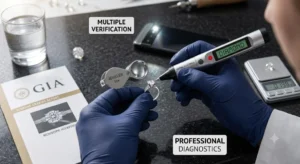
To tell if a diamond is real, the answer usually lies in a portable diagnostic device called a diamond tester pen. These tools utilize a fine-tipped probe to measure how fast heat or electricity moves through a gem. Because diamonds conduct heat incredibly fast, the pen provides a reading in seconds. Advanced dual testers are essential because they measure electrical conductivity as well, allowing jewelers to easily separate diamonds from moissanite, a silicon carbide simulant that mimics diamond heat properties but conducts electricity differently.
Advanced Lab Testing: X-Ray & Spectrometry
For high-value items, the final word always comes from sending your jewelry to a reputable gemmological laboratory. Experts use advanced x-ray machines and spectrometers to analyze the radiolucent molecular structure of a diamond. True diamonds allow x-rays to pass right through them, whereas common substitutes have radiopaque features that show up clearly on the scan, exposing the fake immediately.
The Digital Fraud Alert: Escaping Online Escrow & Marketplace Scams
Modern diamond fraud has evolved past simple glass lookalikes. Scammers are getting highly sophisticated, meaning you must protect yourself during peer-to-peer transactions.
The Fake Serial Number Trap
A massive risk in the modern secondary market involves the fake serial number scam. Fraudsters buy cheap moissanite or cubic zirconia stones cut to exact professional proportions, look up authentic public grading reports online, and use precision lasers to etch a stolen, genuine registration number onto the fake stone’s edge. When an unsuspecting buyer looks through a loupe, the number matches a real database perfectly, even though the stone itself is a counterfeit.
Red Flags on P2P Resale Apps
If you are browsing platforms like Facebook Marketplace or eBay, a sky-high fraud rate makes extreme caution necessary. Always watch out for listings where a seller refuses to meet at a local jewelry boutique for a live screening, or offers a deal that feels completely too good to be true. To protect your investment, consider using secure escrow services and always cross-reference any laser paperwork directly with the issuing laboratory database.
Diamond vs. Common Simulants: Quick Reference
To help you visualize how a genuine stone stacks up against its closest competitors, review this physical property matrix.
FAQs
How to tell if a diamond is real and reflect rainbow colors internally?
No, a real stone does not throw massive rainbow colors from its center. A diamond interacts with light in a disciplined way, reflecting bright white and gray flashes internally while throwing colorful fire outward. If the inside of the stone looks like a rainbow prism, it is likely a simulant.
Can you tell if diamond earrings are real if they are already mounted?
Yes, you can still perform the fog test, the phone flashlight test, and the 10x loupe inspection on mounted earrings. However, you will have to skip the water density test and the dot test, as those require an unmounted stone.
How can you tell if a raw or uncut diamond found in nature is real?
Raw stones do not have the sparkling facets of jewelry. To test an uncut field specimen, you can use a portable tester pen to check its thermal properties, or check its ability to scratch a pre-tested piece of corundum (ruby/sapphire).
Conclusion
Mastering how to tell if a diamond is real comes down to looking for consistency across multiple observations. Simple visual checks, the clean-stone fog test, and the phone flashlight test are brilliant ways to quickly weed out cheap glass or basic cubic zirconia at home. However, given the rise of laser inscription scams and advanced moissanite stones, never rely on a single home method for an expensive purchase. For any jewelry piece worth more than 500 dollars, always protect your money by seeking an independent appraisal from a certified gemmologist.






















Leave a Reply